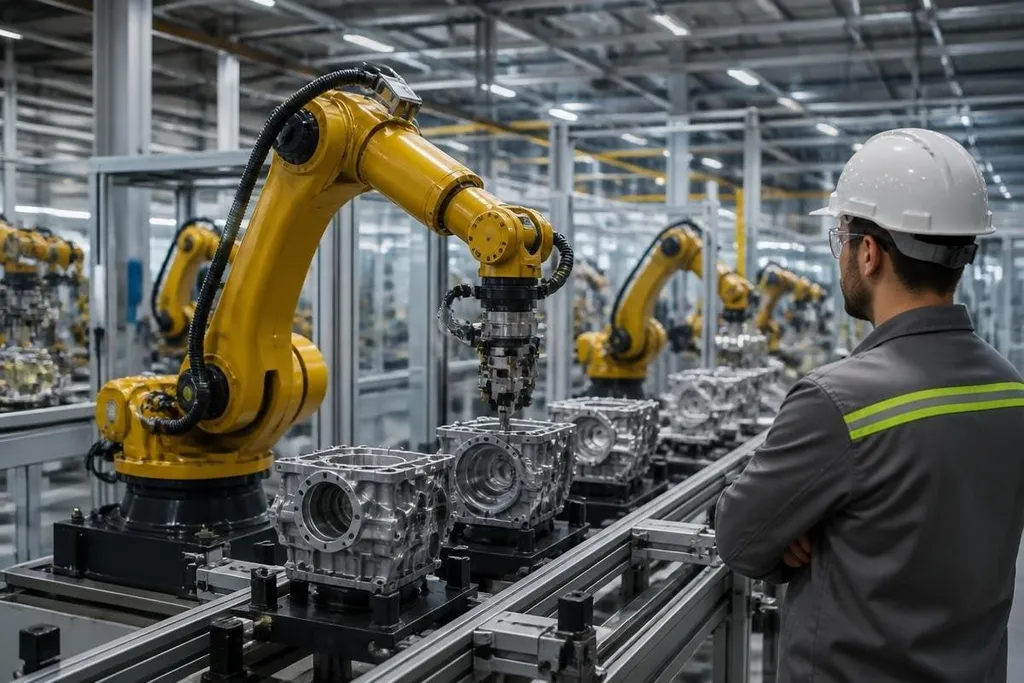
Industrial robots may affect your daily routine long before one enters your kitchen. Their work in factories can change how products are made, repaired, packed, and delivered, which then affects prices, supply, and the jobs around those tasks.
This article looks at the practical chain from factory automation to ordinary life. It also covers where robots still need people, because a machine that repeats one motion well can struggle when the work keeps changing.
- Factory robots can repeat set motions for long periods, with people managing setup and exceptions.
- Their effect may show up in product supply, repair work, food packing, and delivery.
- The hard part is handling unusual objects, changing orders, and safe work around people.
The factory effect reaches your shopping list
An industrial robot usually works inside a fixed process. It may move a part, weld a joint, inspect a surface, or place items into boxes. The robot arm follows a programmed path, while sensors and software check its position and timing.
That setup can change daily life through the products it helps make. If a factory can repeat a task with fewer pauses, it may produce goods more steadily.
That does not guarantee lower prices, since materials, energy, transport, and repair costs still matter. It does mean the factory has another way to handle repeat work.
The same logic applies to products that are hard to assemble by hand. A robot can hold a part at a fixed angle while another tool fastens or joins it. People can then focus on inspection, machine setup, maintenance, and work that needs judgment.
More machines will not remove every human task
Industrial robots work best when the object, path, and result stay within known limits. A box that arrives in the wrong position, a part with a small defect, or a tool that wears down can interrupt the process.
That is why a robot cell needs more than an arm. A cell is the full work area, including the arm, tools, guards, sensors, and control software. Someone must set it up, check its output, fix faults, and decide what happens when the planned process meets an odd case.
Jobs can change around the robot rather than vanish at once. A worker who once loaded parts by hand may spend more time checking the line or feeding the system with new instructions. The shift can still be difficult if training does not match the new work.
The factory changes above can reach your home through products and services shaped by industrial automation. Robot24.com's reporting on home robotics can add specific systems and reported limits, including price where available, before the next section looks at household tasks.
What this could mean at home
You may notice the effects in several ordinary places. A factory robot can support the production of appliances, vehicles, medical equipment, packaging, and building materials. The machine does not need to appear in your home for its work to shape what arrives there.
Repair may change too. Robots can handle repeat inspection steps, while technicians deal with faults that need a person to identify the cause. If companies keep more parts moving through a repair line, some products may spend less time waiting for manual handling.
Food and parcel systems face a different problem. Items vary in shape, weight, and condition, so gripping them safely takes more than a fixed arm path. Cameras, force sensors, and software can help, but the system still needs clear limits and a person who can stop it when the scene changes.
I’d judge industrial robots by the work they can repeat safely for months, not by a short demonstration.
A practical way to judge the change
If you want to know whether a robot project may affect your work or household costs, check these points:
- Name the task: Find the exact motion the robot performs and the person who handles exceptions.
- Check the setting: Look for fixed parts, stable lighting, guards, sensors, and a known work area.
- Follow the cost: Separate robot hardware from energy, maintenance, software, training, and building changes.
- Ask about work: Find out which tasks end, which tasks change, and who gets training for the new process.
- Look for proof: Check whether the system runs on real production work rather than a short staged demonstration.
The useful question is not whether industrial robots will appear everywhere. It is which repeated tasks they can take on, who controls the exceptions, and whether the change reaches you through a product, a workplace, or a repair queue.